WARM UP
Find the starting point.
Students try a short set independently, then explain their choices. The answers show where to begin.
INSIDE THE FIRST LESSON / ERIC KIM
A warm-up, a clear rule, and a chance to explain your answer. Here is how a real first lesson unfolds.
WARM UP
Students try a short set independently, then explain their choices. The answers show where to begin.
SENTENCE STRUCTURE
Find the subject, the verb, and the complete thought. Learn to recognize run-ons and comma splices, then practice three ways to repair them: separate the clauses, join them with a coordinating conjunction, or make one clause dependent.
Students also learn why words such as however and therefore need appropriate punctuation—they cannot join two complete sentences by themselves.
GUIDED PRACTICE
Short practice sets are followed by discussion, so misunderstandings are corrected before the next set. Students explain their answers and apply the rule to more complex sentences.
The goal is to recognize the pattern: a missing verb, a missing connector, or two connectors doing the same job.
VOCABULARY IN CONTEXT
Word parts, images, stories, and rhyme help new words stick. Then students return to the passage: which words signal the meaning, the contrast, or the opposite idea?
For example, uncertainty can point toward speculate; doing something continuously can point toward persistent. Students learn to connect a word to evidence in the sentence.
BETWEEN CLASSES
Finish targeted questions, review the rules, and practice vocabulary with Quizlet. Keep a personal tip sheet and bring questions to the next class.
FROM THE ORIGINAL MATERIALS
Vocabulary connections and a clear progression from concept to application.
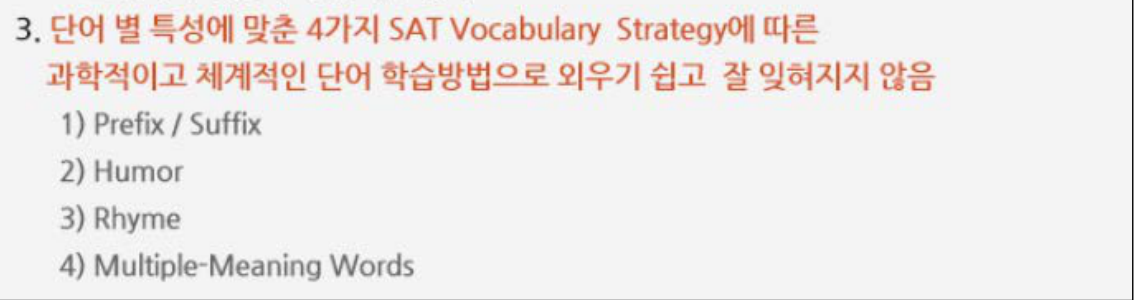
Word parts. Humor. Rhyme. Multiple meanings.
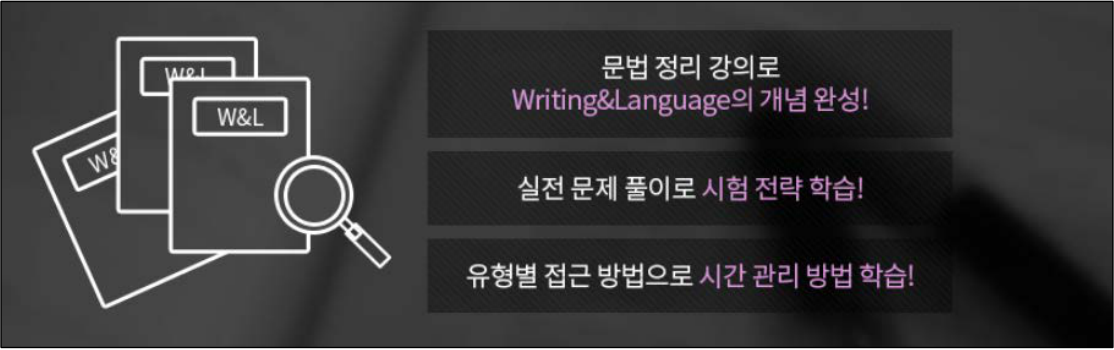
Understand the concept. Apply it. Build fluency.
THE COURSE / AN ORIGINAL 2022 PLAN
Eric’s original summer plan puts the work in a clear order: build the concepts, apply them, and return to the gaps. Vocabulary practice runs throughout.
Work on reading patterns, grammar rules, and math fundamentals one skill at a time.
Apply the concepts to practice questions. Explain the reasoning and keep track of mistakes.
Revisit weak areas, build a personal tip sheet, and decide what deserves another pass.
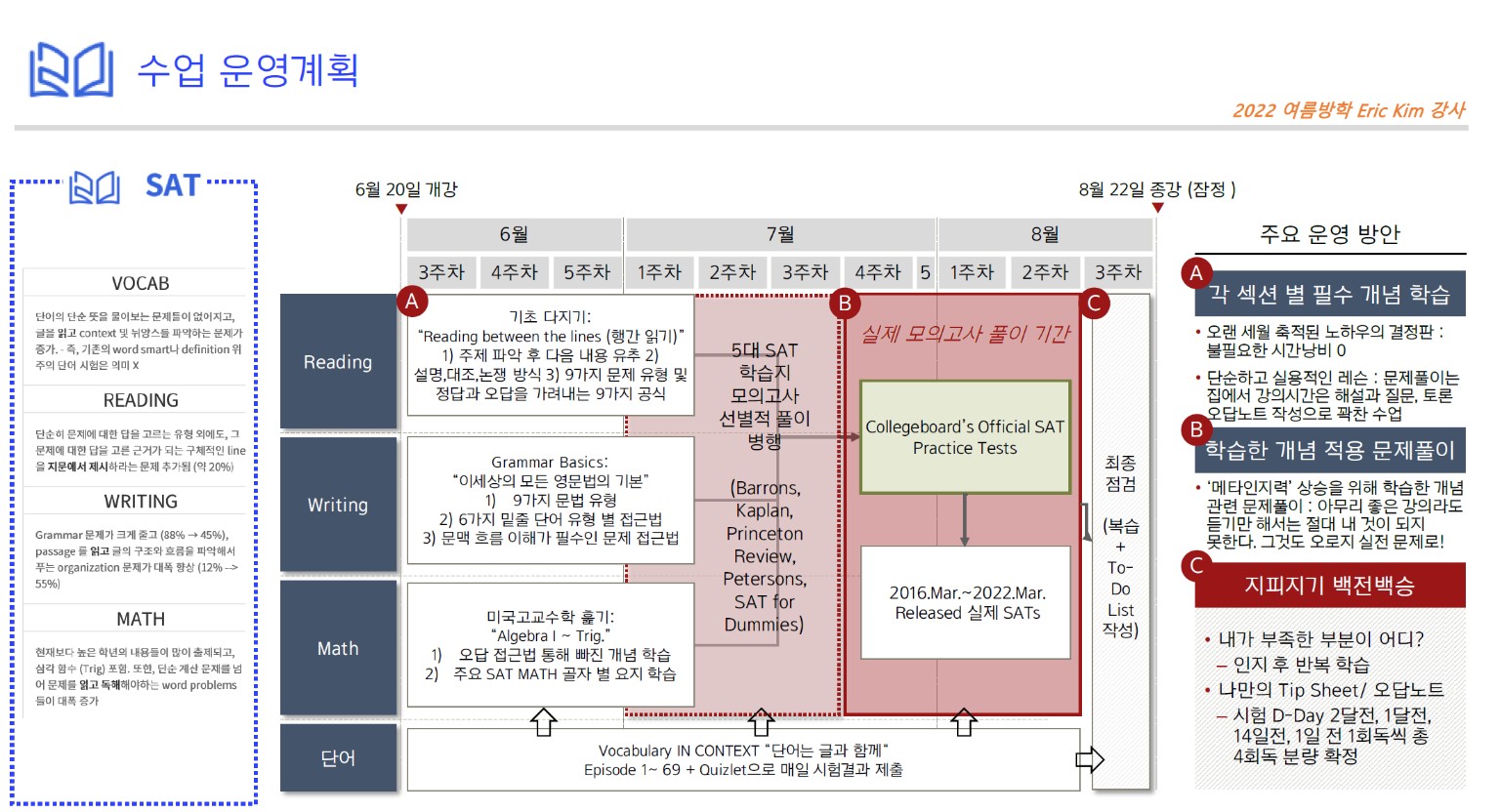
An earlier paper-SAT program. Its dates, test categories, and practice materials are historical; the current Okinawa schedule is confirmed separately.
PROGRESS REPORTS / STUDENT + PARENT + TEACHER
Eric shares progress reports with families, combining score trends, skill-level analysis, and individual answers. Students and parents can ask questions and help shape the next study priorities.
RECENT SCORE TREND
September 2021 · Five assessments · Scale: 400–1600
Scores across successive assessments.
Reading, Writing, and Math skills reviewed separately.
Question type, student answer, and correctness.
Look at progress over time, with practice results, vocabulary quizzes, and official scores kept distinct.
Review question types and individual answers to understand the mistakes behind the total.
Choose focused practice together. Parents can share questions, workload concerns, and observations from home so Eric can adjust the plan.
English adaptation of Eric’s 2021 sample report, with the original score values retained and identifying fields omitted. Historical paper-SAT data illustrates the report format; it is not a current student result or a score guarantee. Individual reports and study priorities are based on each student’s own work.
An English guide to Eric’s 2025 Day 1 lesson and materials. The Okinawa program covers Reading & Writing and Math in English.
Read the philosophy behind the lessons
No charge if you choose not to enroll. Contact Eric for availability and enrollment details.
Ask about your first class