Ideas shared with students and families: how to get past a score plateau, practice with purpose, and find a direction beyond the test.
From my café posts and program archiveEnglish adaptations and student perspectives
Original teaching-philosophy slide from Eric’s earlier program materials.
THE IDEA BEHIND THE LESSONS
Keep the student at the center.
The original graphic puts three ideas in order:
Make learning enjoyable and accessible.
Use the time efficiently and effectively.
Put the student at the center.
English summary of the Korean graphic.
01 / WHEN SCORES PLATEAU
Start with the gap. Make it specific.
Progress starts with a specific gap. Even a familiar topic can hide a small misunderstanding.
A score tells us how the test went. The questions tell us what to work on. I want students to feel comfortable saying, “I don’t understand this part yet.”
A QUESTION TO ASKWhich part of the reasoning becomes unclear—and at what point?
02 / DIAGNOSIS BEFORE MORE PRACTICE
A wrong answer gives us a starting point.
I review wrong answers and uncertain guesses by question type. A correct guess can hide a gap, too.
Then we choose a practical order: which gaps can we address quickly, and which need more time?
A USEFUL REVIEW HABITInclude the questions you guessed, even when you got them right.
03 / CONCEPTS, NOT JUST RULE NAMES
Understand the detail that changes the answer.
Naming a grammar rule is a beginning. Students need to recognize how it applies to the sentence in front of them.
My post on score plateaus used comparison questions as an example: checking singular and plural forms is not enough. The things being compared must also match.
A CHECK FOR UNDERSTANDINGCan you explain why this answer works when the wording changes?
04 / ACTIVE LEARNING
Give repetition a clear purpose.
Students need to answer, check their reasoning, and try again. Repetition is useful when it revisits the precise point that caused confusion.
Similar questions with different wording, followed by mixed practice, show whether the understanding holds.
AFTER A MISTAKEName the misunderstanding, review the idea, and apply it to another question.
05 / THE TEACHER’S ROLE
Help students keep going.
When progress slows, encouragement needs a practical next step. I have compared the teacher’s role to setting the pace for a runner.
Notice recurring problems, give specific guidance, and help students keep going. Each explanation should leave them knowing what to do next.
THE AIMA manageable next step, followed by another.
06 / THE LARGER PICTURE
Start with the student. Keep noticing.
My college-planning notes grew out of parents’ questions about academic interests, activities, and their children’s choices.
My recurring advice: notice what your child naturally enjoys. A prestigious career or major may not be the right direction for that student.
Give interests room to develop through subjects, projects, clubs, and conversations. Let students explore, reflect, and change direction.
FROM STUDENTS / EARLIER COLLEGE CONSULTING
Working with Eric on my college list gave me information about U.S. admissions and encouragement as I made my choices.
College-consulting feedback · January 2021 English translation, condensed
Eric showed me where each college on my list fit—dream, reach, match, or safety—and sent me a spreadsheet so I could make an informed choice.
College-consulting feedback · January 2021 English translation · excerpt
These letters describe Eric’s earlier consulting work with an essay-teaching colleague. The excerpts here concern Eric’s college-list guidance. The current Okinawa class is SAT preparation.
A QUESTION FOR FAMILIESWhat does your student keep choosing to explore—and what might they try next?
07 / A STUDENT PERSPECTIVE FROM THE ARCHIVE
Keep room for life beyond the test.
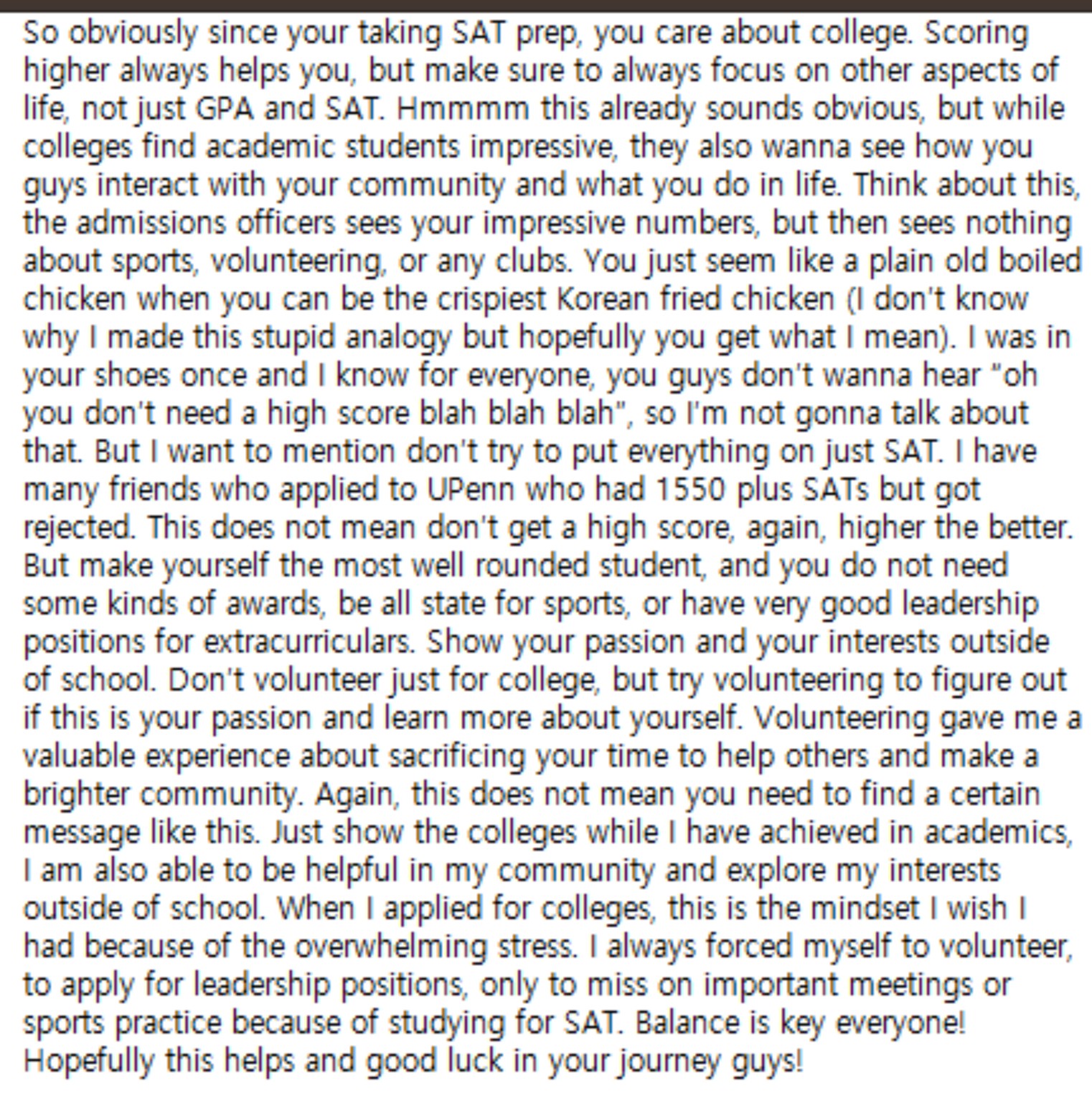
An English reflection from the program archive makes room for sport, clubs, service, and genuine interests alongside SAT preparation.
“Don’t volunteer just for college, but try volunteering to figure out if this is your passion and learn more about yourself.”
Verbatim excerpt from the supplied English reflection
The writer describes missing meetings or sports practice because of SAT study, and looks back wishing for more balance. It is a student’s perspective, rather than an admissions formula.
Read the original English reflection +ORIGINAL ENGLISH REFLECTION · TAP TO ENLARGE ↗
A QUESTION TO KEEP ASKINGWhat are you learning or contributing outside test preparation?
08 / AN APPLICANT LOOKING BACK
Give your story time to take shape.
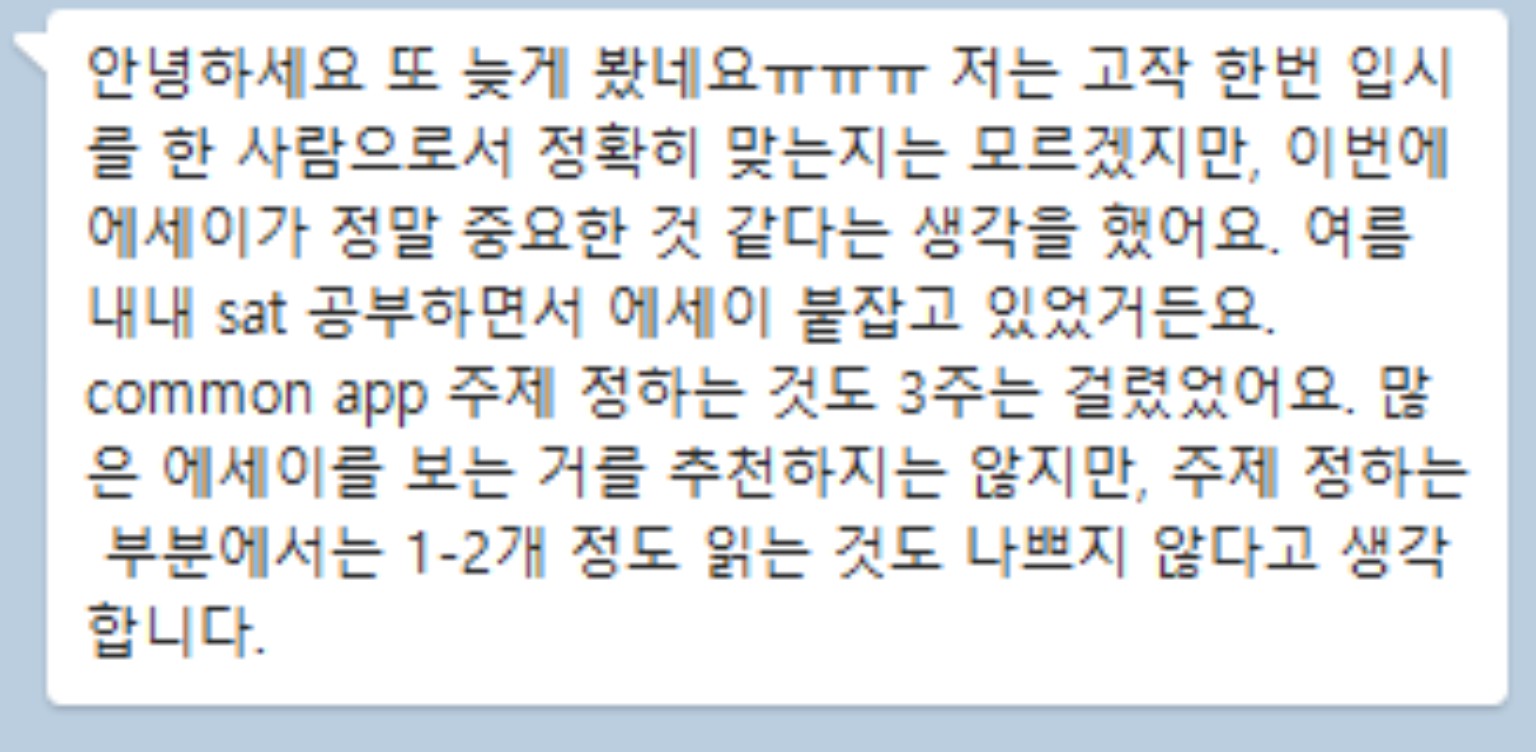
An archived applicant message describes a summer spent preparing for the SAT and writing essays—and the time needed just to choose a topic.
“It took me about three weeks just to choose a topic for the Common App essay.”
English translation of the Korean message · excerpt
The message suggests that one or two examples can help at the topic-selection stage, while discouraging reading a large number of essays. The useful idea is to leave room to discover what you want to say.
See the original Korean message +ORIGINAL KOREAN MESSAGE · TAP TO ENLARGE ↗
A USEFUL STARTKeep notes on experiences and questions that matter to you before trying to turn them into an essay.
Condensed English adaptations of Eric’s café posts on score plateaus (October 2022) and college planning (March 2025), plus his program archive. The college-planning post included AI-assisted research; these notes retain its educational perspective. Student voices and translations are labeled separately.
See these ideas in a lesson.
A concise English guide to the first class: sentence structure, guided practice, and vocabulary in context.